Monday, February 6, 2012


The Leader is Dead

By Nicole Lanzo
September 9th 1976
Beijing times


Beijing~ Mao Zedong, our leader died today on September 9th 1976. Mao Zedong was aged 82. He did a lot of things for China in order to make it a better place. Mao had been in poor health for several years. He declined visibly for at least six months prior to his death. Some reports have said he has died from Lou Gehrig's disease. Lou Gehrig’s disease is a disorder which causes muscle weakness, which can lead to death. At five o'clock in the afternoon on September 2, 1976, Mao suffered a heart attack, which may have contributed to his death.
    Before this event Mao had many accomplishments. Mao was one of the historic figures of the twentieth century. He rose into power by commanding the Long March. Mao was a Chinese Communist revolutionary, guerrilla warfare strategist, Marxist political philosopher, and leader of the Cultural Revolution. Mao was born into a peasant family, so he wanted to make everything about China better. He was in charge of the Four Olds. The Four Olds were Old Customs, Old Culture, Old Habits, and Old Ideas. Even though people were embarrassed or scared of things that may have happened to them by the Red Guards, it was Mao’s way of changing China From old to new. Mao was in office for 33 and ½ years and had many accomplishments throughout his 82 years of life.
    Lin Bao, a witness of the Cultural Revolution had her home searched by the Red Guards. About here experience, she said, “I don’t think Mao did the right thing. A few years ago, Mao’s Red Army searched my home. I was 13 at the time. As I am now 16. I will never forget that day. My little sister Lin Yu got her doll taken away as the doll was wearing Four Olds for clothing. She was very upset because she had  this doll since she was born. I am against Mao because I think he did the wrong thing”.
    Yang Changming is a Red Guard who worked for Chairman Mao. Yang thinks Mao was a great leader. This is what he had to say. “I worked for Mao as long as I can remember. He was a great leader and always tried to do what was best for China. He showed great power and enthusiasm. He taught me a lot as a Red Guard and he always said how we were doing the right thing, helping China become greater”.
    The Leader is dead, but we will always remember the greatness of him. For some people they won’t even think about Mao because of all the trouble they went through because of him.

           Mao Zedong Is Dead And No One Can Replace Him
   
Mao Zedong leader of the Cultural Revolution has died and no one can replace him. He made great decisions and knew how to be a wonderful leader. We will never forget his wonderful achievements. Dying is something that cannot and will not be changed. Loosing him will affect everyone’s life. There is no one that can go and take his position because no one will be as good as Mao.
    Chairman Mao was born into a peasant family so he always tried to make everything about China better. He was a Chinese Communist revolutionary, guerrilla warfare strategist, Marxist political philosopher, and leader of the Cultural Revolution. Mao was in office for 33 ½  years which is a long time to be the great leader he was. Mao’s achievements are the major reason why no one can replace him. Mao was the leader of the Cultural Revolution which lasted 10 years. He accomplished a lot within it. He turned China from old to new. He is the one who put the Four Olds into motion. He did what was best for the rest of China. Under his leadership, China became one of the most industrialized countries in the world.
    Some people might think Mao was a bad person and a bad leader. That isn’t true because there are reasons for all of the things that may have gotten you angry with him. For example, homes getting searched angered many people. This is because he was turning China from old to new. He did not want to find Four Olds within your home so there had to be a way to change that. You have to remember him as someone who was only trying to make things better because that is what he was doing.
    You have to remember that Mao wasn’t trying to make bad things happen to people. He meant it for the best. Mao Zedong is dead and no one can replace him.


Map of the Cultural Revolution
By Nicole Lanzo


    The Cultural Revolution took place from October 1966 until October 1976. The previous dynasty was the Qing Dynasty. China during the Cultural Revolution borders countries including Mongolia, Russia, North Korea, Kazakhstan, and Kyrgyzstan. It also borders the Pacific Ocean. The capital is Beijing. Beijing is located in northeastern China. Shaoshan, Hunan Province, China is a important place in Mao’s life because this is where he was born. The differences between modern Chinese borders and the Qing Dynasty is that Mongolia is part of the Qing Dynasty and not China in the Cultural Revolution. China during the Cultural Revolution includes all of China while the Qing Dynasty includes all of China plus Mongolia.  All though the Qing Dynasty is bigger than China during the cultural Revolution, the Cultural Revolution has a lot to be proud of because of all of its achievements.


My Interview With Mao Zedong
Nicole Lanzo
Q: How did your life as a young kid impact your future?
A: I was born into a peasant family so all throughout life I wanted to make China a better place. I believed that all problems of China could be fixed within China. As I grew older I began to rule more and more and accomplish those goals I had as a young kids.

Q: What would you say your major accomplishments in life are?
A: Turning China from old to new. I did this by putting the Four Olds into motion. I had the red guards search peoples homes. People got angry with me for doing this and they did not like it. You have to remember that the Four Olds were set into motion for a reason, I made China a better place.

Q: Who influenced you on your work?
A: I’ve had many people who have stepped into my life and influenced me. I would say that my mom and dad has influenced me the most. They taught me what was right and wrong as a young kid until i got older. They told me what was wrong with China and how it could be fixed. i wanted to be the one who fixed China.

Q: Who are some people that have helped with your work?
A:  There were some people that I have gathered to aid me in my attack on the leadership of the Communist Party. These people were important to me. The people were, my wife Jiang Qing, the Minister of Defense Lin Biao, Chen Boda, Kang Sheng, and Wang Dongxing. They all worked very hard to help me with everything. Besides all these people there were many others that have stepped in through my 33 ½ years of ruling.

Q: Thank you so much for taking the time to talk with me. Now how is your health?
A: Your very welcome. I’m hanging in there. Today is September 7, 1976. A couple of days ago I suffered a horrible heart attack at 5 o’clock in the morning. I am happy to be okay now. I don’t feel 100% but I’m hoping I will within the next couple of days.


An Average Day with My Host Family
Nicole Lanzo
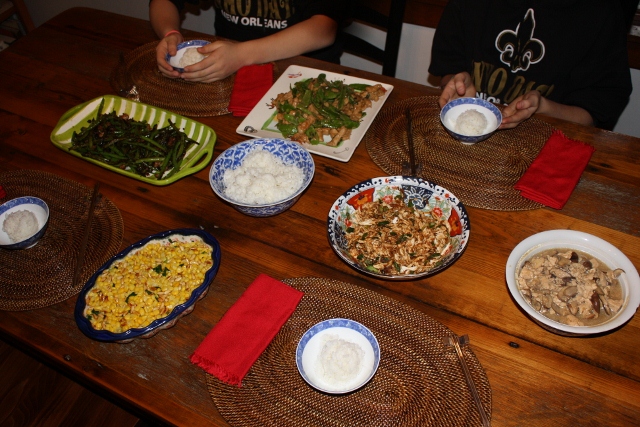
The Family I visited lived in Beijing. They were peasants. This means that our life was very tough on us. We had to watch out for things such as our home being searched. The family worked very hard on the farm. They all worked together and never gave up. For fun, we would do certain types of things like drawing, tag, and we even told stories to each other. The funniest part of the day was listening to the family tell stories because it was very interesting. For an example grandpa Feng Chang would talk about when he was a kid and what types of things he would do. The family did not pray to Mao. They think that he was a bad person. They prayed to God because they believed that he was the only person that could resolve the problem of being peasants. We ate many different foods but the major food that we always ate was rice, white rice. It had a delicious taste that just melts in your mouth. Yum, so good! The government had many rules that were ridiculous to follow. We weren't allowed to have Four Olds. It was very difficult to hide them from the Red Guards. I know this because while I was there our home was searched. Our clothes that we wore were different from America. It was as if we were dressed up all year round. I wore a skirt with a pretty blouse. The boys would wear dress pants with a dress shirt. The time I was with the family was very fun. It was nice to explore the types of things that were done in Beijing and in a peasant family.
    At the beginning of the day when I woke up, we had breakfast. Mom made some cake that went with some tea. I played with daughter Feng Li (who is my age) in the morning too. We played tag. Feng Li started telling me that her family’s house could be searched at any moment. She told me how there was a landlord in her family. I hoped that the Red guards wouldn’t come during my visit. We continued too play some more.
    In the middle of the day, we ate some lunch. Soup with bread. Everyone looked suspicious around the house, it was so weird. Next thing I knew dozens of Red Guards barged into the door. They said they were looking for Four Olds. The Reds guards were calling the Feng family all sorts of names that I could not believe was even allowed. They trashed the house. Paper was thrown all over the floor, beds were tipped over a long with couches, and desks. I hoped that in the end everything would be okay. The Red Guard left with some boxes. It seemed as if they had gotten everything they were looking for.
    At the end of the day, we all tried cleaning the house up a bit. Fixing furniture back to the way it should be. Everyone seemed to be quiet about the search. I didn’t ask many questions because I felt bad for the Feng family. After tidying up the house, we ate dinner. Rice, my favorite. They made there rice so good, I could eat it any day. At this time It was getting close to when I would have to leave. I spent a good hour saying by to everyone. It was sad that it was time to go. As I was leaving I prayed that their house wouldn’t be searched again. I wouldn’t want that to happen to them. Feng Li walked me out. I gave her a hug and headed on down the road.
    A day with my host family was very fun. They were very polite the way they took me in and treated me like one of them. It is different there than it is here. Nothing I ever expected it to be. I’d love to and I would go back any day.


BIBLIOGRAPHY
Works Cited
“China Beliefs.” China Travel. N.p., 5 Feb. 2012. Web. 5 Feb. 2012. <http://www.justchina.org/‌china/‌china-beliefs.asp>.
“Cultural Revolution.” wikipedia.  Wikimedia Foundation, 28 Jan. 2012. Web. 5 Feb. 2012. <http://en.wikipedia.org/‌wiki/‌Cultural_Revolution>.
Famous People. N.p., n.d. Web. 1 Feb. 2012. <http://www.thefamouspeople.com/‌profiles/‌mao-zedong-56.php>.
“Four Olds.” Wikipedia. Wikimedia Foundation, 5 Feb. 2012. Web. 5 Feb. 2012. <http://en.wikipedia.org/‌wiki/‌Four_Olds>.
“The Great Leap Forward.” History Learning. N.p., 2012. Web. 5 Feb. 2012. <http://www.historylearningsite.co.uk/‌great_leap_forward.htm>.
“The Great Leap Forward Period in China, 1958-1960.” SJSU. San José State University  Department of Economics, n.d. Web. 5 Feb. 2012. <http://www.sjsu.edu/‌faculty/‌watkins/‌greatleap.htm>.
Library Think Quest. Oracle Education Foundation, n.d. Web. 4 Feb. 2012. <http://library.thinkquest.org/‌26469/‌cultural-revolution/>.
“Mao’s Little Red Book.” Fortunecity. N.p., n.d. Web. 5 Feb. 2012. <http://members.fortunecity.com/‌stalinmao/‌China/‌Zedong/‌Redbook.html>.
“Mao Zedong.” Wikipedia. Wikimedia Foundation, 5 Feb. 2012. Web. 5 Feb. 2012. <http://en.wikipedia.org/‌wiki/‌Mao_Zedong>.
“Mao Zedong, Zhou Enlai, and Deng Xiaoping.” Three Chinese Leaders. Asia for Educators, Columbia University, 2009. Web. 5 Feb. 2012. <http://afe.easia.columbia.edu/‌special/‌china_1950_leaders.htm>.
“Music of China.” Wikipedia. Wikimedia Foundation, 5 Feb. 2012. Web. 5 Feb. 2012. <http://en.wikipedia.org/‌wiki/‌Music_of_China>.
“Political Religion: The Case of the Cultural Revolution in China.” Sociology of Religion. N.p., n.d. Web. 5 Feb. 2012. <http://socrel.oxfordjournals.org/‌content/‌52/‌1/‌99.abstract>.
Washington edu. N.p., n.d. Web. 4 Feb. 2012. <http://depts.washington.edu/‌chinaciv/‌graph/‌9wenge.htm>.
“Women in China: Past and the Present.” Chinese Cultural Studies. N.p., n.d. Web. 5 Feb. 2012. <http://acc6.its.brooklyn.cuny.edu/‌~phalsall/‌texts/‌chinwomn.html>.